Web Design in Nepal: The 2026 Guide to Web Development That Grows Your Business
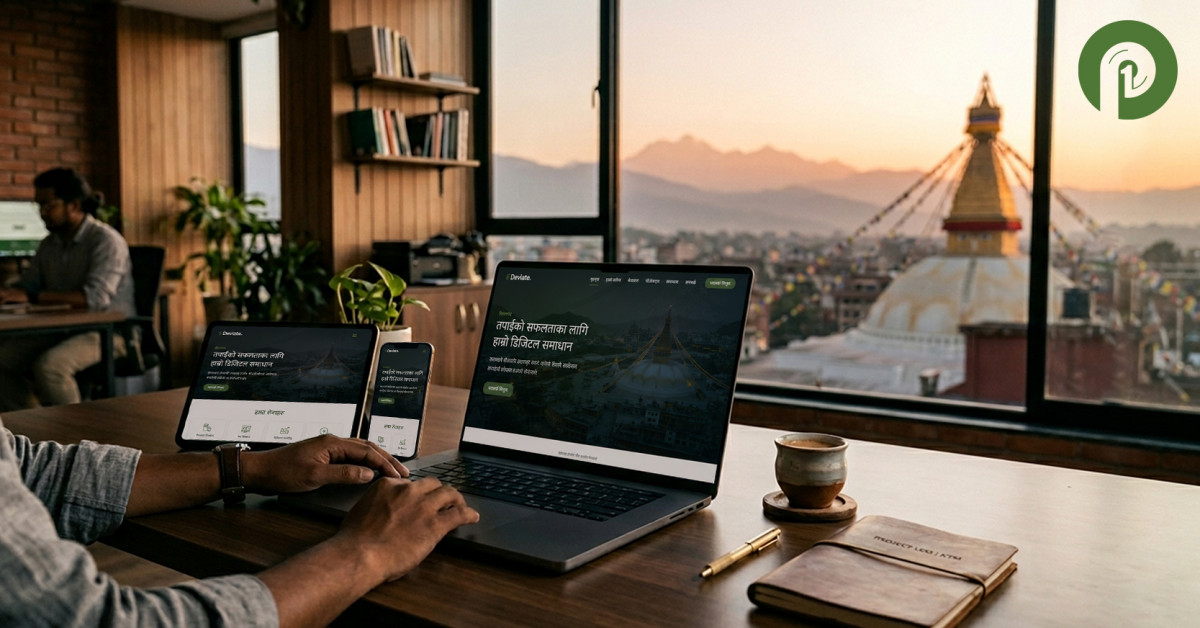
Nepal's internet economy has quietly crossed an inflection point. Mobile data is cheaper than ever, digital payments are mainstream, and customers from Pokhara to New York are searching for Nepali brands online before they ever pick up a phone. In that landscape, your website is no longer a digital business card — it is the storefront, salesperson, and brand experience rolled into one.
That is why web design in Nepal has evolved from a checkbox into a core business decision. The right website wins trust in five seconds, ranks on Google for the keywords your customers actually use, loads fast on a 4G connection in Itahari, and converts visitors into paying customers. The wrong one quietly costs you leads every single day.
This guide breaks down what modern web design and web development in Nepal really involves in 2026 — what a quality site looks like, what it should cost, the tech stack that powers it, and how to pick a partner who will build something that lasts.
Why Web Design in Nepal Matters More Than Ever
A decade ago, a "Nepali website" often meant a slow, template-based brochure built once and forgotten. Today, the bar has moved sharply higher, and the businesses that win online tend to share three traits.
They are mobile-first. Nepal essentially skipped the desktop internet era and went straight to mobile. According to DataReportal's Digital 2026 Nepal report, the country had 16.6 million internet users by the end of 2025, with online penetration at roughly 56% of the population — and 32.4 million active mobile connections, the equivalent of 109% of the population because so many users carry more than one SIM. A site that looks great on a Macbook but breaks on a mid-range Android is bleeding revenue.
They are search-visible. Whether your customer is searching "best momos near Lazimpat," "trekking package Annapurna," or "industrial steel supplier Nepal," they expect to find an answer on page one. Web design and SEO are no longer separate disciplines.
They convert. A pretty homepage that nobody calls, books, or buys from is decoration. Modern websites in Nepal are engineered around clear calls to action, fast load times, trust signals, and frictionless checkout — especially for e-commerce.
This is the standard you should expect from any serious web design company in Nepal in 2026.
What Defines Great Web Design in Nepal Today
Good web design is not about visual flourish. It is about removing friction between a visitor's intent and your business outcome. Here is what separates a website that performs from one that just exists.
Responsive, mobile-first layouts
Your site must render cleanly across phones, tablets, laptops, and large desktops. That means flexible grids, touch-friendly buttons, optimized images, and typography that stays readable at every breakpoint. If your audience is split between Nepal and the diaspora, this matters even more — connection speeds and device sizes vary widely.
Speed and Core Web Vitals
Google now ranks sites partly on how fast they feel. Its Core Web Vitals standard measures real-user load speed, interactivity, and visual stability — and a homepage that takes seven seconds to load on a Ncell connection in Biratnagar will lose visitors before they ever see your offer. Good agencies optimize images, minify code, lazy-load assets, and run PageSpeed Insights and Pingdom checks as part of delivery.
SEO baked into the structure
A site cannot be retrofitted for SEO after launch and expect to compete. Clean URL structures, semantic HTML, schema markup (the structured data Google uses to understand what a page is about), fast indexable pages, optimized meta tags, and a sensible internal linking architecture must be built in from day one. This is where web design and web development in Nepal converge with search marketing.
Local integrations that actually matter
A great Nepali website speaks the local commercial language: eSewa and Khalti payment integration for e-commerce, WhatsApp and Viber click-to-chat for service businesses, Google Map embeds for physical stores, Devanagari font handling where you need bilingual content, and proper handling of NPR currency. These are not nice-to-haves — they are the difference between a sale and a bounce.
Trust and conversion design
Testimonials, real client logos, certifications, secure-checkout badges, transparent pricing, and clear contact information all reduce the perceived risk of doing business with you. Conversion-focused design is what turns traffic into revenue, and it is the lens every page should be designed through.
Web Development in Nepal: The Engine Behind Every Great Site
If web design is what visitors see, web development is what makes it work. Web development in Nepal today spans several layers, and your choice of stack will shape your site's performance, security, and long-term cost.
Custom development vs. templated builders
Drag-and-drop builders like Wix or Shopify can get you online quickly, but they trade flexibility, performance, and SEO depth for convenience. Custom-coded sites — typically built on frameworks like Laravel (a PHP framework that powers a large share of bespoke business websites globally) for the backend or WordPress with custom themes — give you full control over how your site looks, scales, and ranks. For most growing Nepali businesses, custom is the better long-term investment.
Content management systems (CMS)
A modern site should be editable by your team without a developer in the loop. A content management system (CMS) is simply the admin panel that lets non-technical staff add pages, change images, and publish blog posts. WordPress remains the most popular CMS globally and works well for content-heavy sites and blogs. Laravel-based custom CMS solutions are increasingly common in Nepal for businesses that need bespoke admin workflows, complex permissions, or deep API integrations. Either way, your team should be able to update content, upload images, and add pages without writing code.
E-commerce architecture
If you are selling online, your stack must handle product catalogues, inventory, multi-currency pricing, shipping rules, tax logic, and Nepali payment gateways. eSewa, Khalti, FonePay, and IME Pay integrations are now table stakes. International credit-card processing through Stripe or 2C2P matters if you sell to the diaspora or export markets. A robust shopping cart, abandoned-cart recovery, and clean order management dashboards are non-negotiable.
Hosting, security, and SSL
Where your site lives matters. Reputable hosting, free lifetime SSL, regular backups, malware scanning, and a clear maintenance plan keep you safe from the kind of downtime and data breaches that quietly destroy customer trust. A good development partner will either host your site or guide you to a hosting setup that fits your traffic and budget.
APIs and third-party integrations
Modern websites talk to other systems — CRMs like HubSpot or Zoho, email platforms like Mailchimp, accounting tools, ERP systems, booking engines, and shipping APIs. An API-ready website saves you hours of manual data entry every week and makes scaling much easier down the road.
How Much Does Web Design and Web Development in Nepal Cost?
Pricing is the question every business owner asks first, and the honest answer is: it depends on scope. But you can think in tiers.
| Website Type | Typical Price Range (NPR) | What's Usually Included |
|---|---|---|
| Corporate / Portfolio Site | 60,000 – 1,50,000 | 8–15 pages, services, blog, contact forms, self-managed CMS |
| E-commerce Site | 1,00,000 – 5,00,000 | Product management, payment gateways, customer accounts, admin dashboards |
| Travel & Tours Site | 1,00,000 – 2,00,000 | Package listings, booking forms, itinerary management, payment handling |
A corporate or portfolio website is the right tier for most SMEs, professional service firms, clinics, schools, and B2B businesses.
An e-commerce site's wide range reflects how dramatically scope can vary — catalogue size, multi-vendor needs, and custom features all push the number up.
What inflates cost in any tier: custom integrations, large product catalogues, multilingual support, complex booking logic, custom dashboards, and heavy ongoing content production. What keeps cost reasonable: clear scope upfront, reusable design components, and a partner who scopes the project honestly rather than padding the quote.
A standard build from a reputable agency will include CMS setup, unlimited pages, image media management, admin user roles, blog functionality, form handling, and post-launch support. Hosting, content writing, photography, and SEO retainers are typically priced separately — and you should ask for clarity on this before you sign.
How to Choose the Right Web Design Company in Nepal
Not every agency offering web design in Nepal is the right fit for your business. Use this short framework when shortlisting partners.
Look at the portfolio, not the pitch. Open their client websites on your phone. Are they fast? Do the forms work? Do they look like they were built in 2025, or 2015? Real work tells you more than any sales deck.
Ask about the process. A serious agency will walk you through discovery, wireframing, UI design, development, testing, deployment, and post-launch optimization as distinct phases — not as a single black box. If they cannot explain their process clearly, they probably do not have one.
Check for SEO competence. Web design and SEO are inseparable. Ask how they handle on-page SEO, page speed, schema markup, and analytics setup. If the answer is vague, your site will be vague on Google too.
Confirm post-launch support. Websites are not "done" at launch — they need updates, security patches, content changes, and tweaks based on real user behaviour. Find out what is included in the first year and what costs extra.
Read client testimonials and case studies. Look for specifics: what business problem was solved, what changed after launch, what the working relationship was like. Vague praise is a yellow flag.
Avoid fixed-template shops unless you genuinely need a brochure site fast and cheap. Custom design tailored to your brand will almost always serve you better over a 3–5 year horizon.
How Pedal Advertising Approaches Web Design and Web Development in Nepal
At Pedal Advertising, we build websites the way we would build them for ourselves — custom-coded, conversion-focused, SEO-ready from day one, and supported long after launch. We do not work on fixed templates. Every site is shaped around the client's brand, audience, and commercial goals.
Our web design and development service follows a nine-step process refined over years of work with clients across automotive, hospitality, education, manufacturing, healthcare, and e-commerce: requirements gathering, concept and research, UI/UX design, development, testing, deployment, page-speed optimization, SEO setup, and ongoing maintenance.
Under the hood, we typically build on Laravel for custom applications and WordPress for content-driven sites, with eSewa, Khalti, and international payment gateway integrations for e-commerce. Every project includes a self-managed admin panel, free lifetime SSL, mobile-tablet-desktop responsiveness, Google Map and social integration, WhatsApp and Messenger API hooks, and one full year of free support.
Mini case study: CMS Hospitality
When CMS Hospitality came to us, they needed a digital presence that matched the standards of the hospitality clients they serve — not a generic brochure site. We worked alongside their executive team on both their brand logo and a custom-built website designed to turn visitor curiosity into qualified inquiries, with admin tooling their internal team could manage without a developer. Their Executive Director, Mr. Singh Bahadur Moktan, has described the engagement as one that "transformed our vision into reality" — and the site continues to serve as their primary B2B inbound channel.
That kind of integrated brand-plus-web outcome is what we aim for on every project. We've shipped similar work for Jagdamba Steels, Mastakala Crafts, Vatsalya, KFA, Sipradi (TATA Motors), National IVF, and Doctors Hub Nepal, among others — the common thread being design that reflects the brand, code that performs, and a process that respects deadlines.
Because we sit inside a full-stack digital marketing agency, your website is also engineered to work alongside SEO, content marketing, paid search, and social media marketing — not as a standalone asset, but as the centre of your digital growth engine.
Frequently Asked Questions About Web Design in Nepal
How long does it take to build a website in Nepal?
A standard corporate website typically takes 3–6 weeks from kickoff to launch. E-commerce builds usually run 6–12 weeks depending on catalogue size, payment integrations, and custom features. Timelines stretch when content (text, images, product data) is delayed on the client side — a good agency will flag this early.
What is the difference between web design and web development?
Web design covers the visual and user-experience layer — how the site looks, how visitors move through it, and how it feels on different devices. Web development covers the technical layer — the code, CMS, database, integrations, and infrastructure that make the design actually work. You need both, and they should be built together from day one.
Do I need WordPress or a custom-built site?
WordPress is excellent for content-heavy sites, blogs, and most small-to-medium businesses. A custom-built site (typically on Laravel or a similar framework) is the right choice when you need complex workflows, deep integrations, unusual admin requirements, or maximum control over performance. A good agency will recommend the right stack based on your goals, not their preference.
Can my website accept eSewa and Khalti payments?
Yes. Both eSewa and Khalti offer merchant APIs that integrate cleanly into custom-built websites and most CMS platforms. If you sell to international customers as well, Stripe and 2C2P can run alongside the local gateways. Any serious web development in Nepal partner should handle this as routine work.
Will my website rank on Google after launch?
A well-built site is technically ready to rank — but ranking itself takes ongoing SEO work: keyword targeting, content publishing, backlink building, and continuous optimization. Expect 3–6 months before you see meaningful traffic from organic search for competitive keywords, and longer for highly competitive niches.
Do you offer website maintenance after launch?
Most quality agencies in Nepal — Pedal Advertising included — offer free post-launch support for the first year covering bug fixes, security updates, and minor content tweaks. Beyond that, you can either move to a monthly maintenance retainer or handle updates in-house through your admin panel.
Build a Website Your Business Actually Deserves
Your website is the single most leveraged asset in your digital marketing — and treating it like one changes outcomes. Done right, web design in Nepal is no longer about looking professional. It is about loading fast, ranking high, converting visitors, integrating with the tools your business already uses, and growing alongside your brand for years to come.
If you are planning a new site, redesigning an outdated one, or simply not sure where to start, the team at Pedal Advertising will walk you through the options honestly and quote you fairly.
Ready to start?
Book a free consultation with Pedal Advertising, or call 01-5432700 / +977-9813602774.
We are based in Kupondole Heights, Kathmandu, and we work with clients across Nepal and internationally.
You may be also interested in
Local SEO in Nepal: The Complete Guide to Ranking on Google Maps
What Is Local SEO, and Why Does It Matter in Nepal Specifically Local SEO is the process of optimizing your online presence so your business appears...
Web Design in Nepal: The 2026 Guide to Web Development That Grows Your Business
Nepal's internet economy has quietly crossed an inflection point. Mobile data is cheaper than ever, digital payments are mainstream, and customers fro...

4 Must-know Latest Social Media Marketing Trend in 2025
Social Media Marketing Trends Social media marketing simply is strategizing through social media to reach out to your customers and potential custome...

Leveraging social media marketing in 2025
1. What is social media marketing? Social media has been one of the major platforms for marketing purpose lately. The captivating and engaging nature...
Choosing the Best Web Design Company in Nepal: A Comprehensive Guide
In today's digital age, a strong online presence is no longer a luxury—it's a necessity. For businesses in Nepal, a well-designed website serves...